Welcome to our blog postings! We hope you are just as excited as we are about this new feature for our department. We are looking forward to sharing our classrooms, thoughts, and ideas with you and are even more excited about hearing from each of you. As parents, you play a vital role in our classroom, and we want you to be a part of each day. We are excited to start this adventure with you!
Our class began Unit 3 Forces a couple of weeks ago, and we are still working on this unit. In order to begin a unit on forces, students have to gain a working knowledge of Newton's Laws of Motion. However, I have found that many of the students, while understanding general ideas of forces, do not have the basic foundational skills and conceptual knowledge necessary to scaffold and build upon with new information.
Therefore, I immediately located activities, labs, and simulations for students to manipulate. My first finding was from phet.colorado.edu for students to experience. This website is a host of great simulations that will be beneficial for the students throughout the year. One specifically titled "Forces and Motion: Basics" is based on the traditional ideas of the game "tug-of-war" and explores the aspects of motion associated with opposing forces. You can experience what your students are learning by manipulating the simulation. Just click on the simulation, try it out, and post some of your thoughts in the comment section!
Through my searches, I also found a great resource for students who are struggling with the definitions of Newton's Laws of Motion. We spent some time exploring each of the three laws, and this simple demonstration integrates scientific vocabulary and the laws to build conceptual understanding and work on scientific language skills. You can also check it out with your student and have them explain the meaning behind each law. The link to the simulation is the Science Channel.
As you can see, we are fully integrating technology into our learning environment and receiving many benefits from it. The technology allows us to manipulate scenarios and situations that we observe in our daily lives but have difficulties exploring in a traditional classroom. Continue to follow our learning and experience our exploration with technology throughout this unit!
Our first major unit of the year focused on Kinematics, or motion. Initially, we talked about motion being relative to any position. For example, we could be standing still, but when we thought on a larger scale, we are moving because we are on the Earth as it spins and moves around the sun. Additionally, on a smaller scale, we could be standing still, but our bodies are in constant motion- digesting food, thinking thoughts, and many other processes. It is all relative to scale and proportion, one of our cross-cutting concepts.
After understanding this concept, we spoke about the differences between speed, velocity, and acceleration and how they interact in linear motion.
During this section of the unit, we discussed free fall and the acceleration due to gravity. We also looked at last year's Space Jump by Felix Baumgartner. I have attached a portion of his jump for you to view.
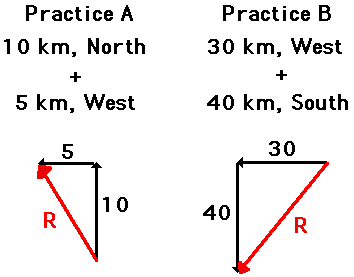
Vector Examples
In the middle of this unit, we looked into the role of vectors, and finally, we proceeded to examine curved motion, or motion in two components instead of one. We explored several simulations from the phet.colorado website during this time. The simulation on Projectile Motion is included. Just click the image to open the simulation:
I think this unit was very successful, and the students enjoyed it. Kinematics forms the foundation for us to continue to build upon for the rest of the year. If you would, ask your student about this unit and post some of their ideas on what they learned/enjoyed the most!
At the beginning of the year, we worked on establishing the differences between science, technology, and engineering. The students explored the definitions of each of these, and then, we began looking at how each of these is connected and dependent on the others. We came to the conclusion that science is a way of thinking. Technology is the application of the knowledge of science, and engineering is building these technologies based on science. The students really enjoyed this activity because they began to see that most things we encounter on a daily basis are some form of engineering and technology that are based on science. Of course, these examples included iPods, Macbooks, PCs, and a slew of other typical technologies. However, the students started to see pens, pencils, whiteboards, backpacks, and so many more as technology! Some of the students started to develop the idea that technology plays an integral role in the classroom. In keeping with the paradigm shift, I have continued to expose the students to many different technologies that enhance the classroom. We have explored animations and simulations. I have allowed them to become creative in how they turn in assignments, highlighting new sources of technology. Now, we have students looking at their digital cameras as outlets for exploring science! I will continue cultivating the importance of technology in the classroom in order to give the students experience in daily technologies that are relevant to the classroom, and ultimately, produce well-balanced, technologically savvy individuals who are equipped to handle the many facets of the technology age.
The following is an article on Digital Literacy and the 21st Century Skills we want our students to have. Feel free to check it out: Digital Literacy Article. Also, while this video is directed towards teachers, I think that the information in this video is important for parents to view. It is a little overwhelming, but it is a reflection of the students in this age:
Welcome to the blog postings of the Science Department! We will be using this method of communication in addition to our traditional forms. For my first post, I have included information about the Next Generation Science Standards. As many of you know, we approach science through the "Physics First" model. Physics is taught in the 9th grade, followed by Chemistry, Biology, and Anatomy and Physiology. This sequence enables the students to build on each subsequent course throughout their high school career for a more well-rounded and integrated understanding of science. However, the strong foundation of this sequence is not enough for the students to experience genuine learning with science. Therefore, we have started to integrate the practices and cross-cutting concepts of the Next Generation Science Standards to foster global thinking and the practical application of science with your students. Even though we are currently not held to these standards, the state of Georgia has been an integral part in compiling a more beneficial set of science standards. The goal of having new standards is to create a better vision of science and its application with students. We want the students to engage in science learning and see the connections to their daily lives.
These cross-cutting concepts include:
Patterns, Scale and Proportion, Systems and Models, Structure and Function, Energy and Matter, Cause and Effect, and Stability and Change.
You can read more about these standards at Next Generation Science Standards.